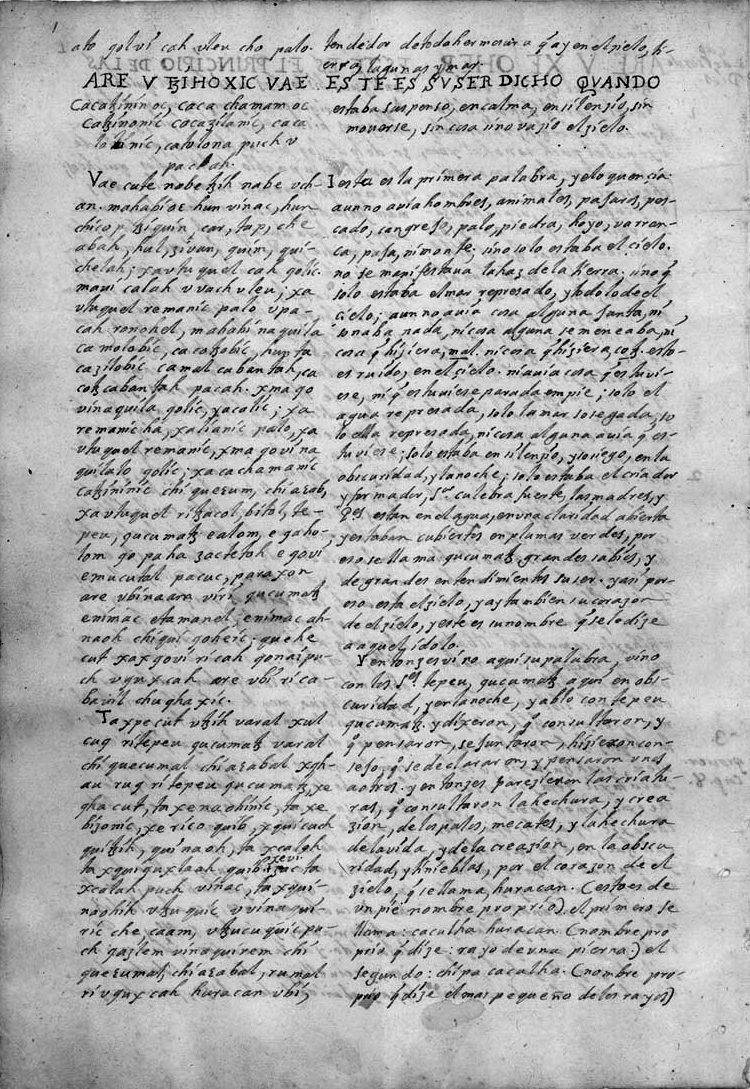
It is generally believed that Ximénez borrowed a phonetic manuscript from a parishioner for his source, although Néstor Quiroa points out that “such a manuscript has never been found, and thus Ximenez’s work represents the only source for scholarly studies.”[15] This document would have been a phonetic rendering of an oral recitation performed in or around Santa Cruz del Quiché shortly following Pedro de Alvarado’s 1524 conquest.
By comparing the genealogy at the end of Popol Vuh with dated colonial records, Adrián Recinos and Dennis Tedlock suggest a date between 1554 and 1558.[16] But to the extent that the text speaks of a “written” document, Woodruff cautions that “critics appear to have taken the text of the first folio recto too much at face value in drawing conclusions about Popol Vuh‘s survival.”[17] If there was an early post-conquest document, one theory (first proposed by Rudolf Schuller) ascribes the phonetic authorship to Diego Reynoso, one of the signatories of the Título de Totonicapán.[18]
Another possible author could have been Don Cristóbal Velasco, who, also in Titulo de Totonicapán, is listed as “Nim Chokoh Cavec” (‘Great Steward of the Kaweq’).[19][20] In either case, the colonial presence is clear in Popol Vuh‘s preamble: “This we shall write now under the Law of God and Christianity; we shall bring it to light because now the Popol Vuh, as it is called, cannot be seen any more, in which was clearly seen the coming from the other side of the sea and the narration of our obscurity, and our life was clearly seen.”[21] Accordingly, the need to “preserve” the content presupposes an imminent disappearance of the content, and therefore, Edmonson theorized a pre-conquest glyphic codex. No evidence of such a codex has yet been found.
A minority, however, disputes the existence of pre-Ximénez texts on the same basis that is used to argue their existence. Both positions are based on two statements by Ximénez. The first of these comes from Historia de la provincia where Ximénez writes that he found various texts during his curacy of Santo Tomás Chichicastenango that were guarded with such secrecy “that not even a trace of it was revealed among the elder ministers” although “almost all of them have it memorized.”[22] The second passage used to argue pre-Ximénez texts comes from Ximénez’s addendum to Popol Vuh. There he states that many of the natives’ practices can be “seen in a book that they have, something like a prophecy, from the beginning of their [pre-Christian] days, where they have all the months and signs corresponding to each day, one of which I have in my possession.”[23]
Scherzer explains in a footnote that what Ximénez is referencing “is only a secret calendar” and that he himself had “found this rustic calendar previously in various indigenous towns in the Guatemalan highlands” during his travels with Wagner.[24] This presents a contradiction because the item which Ximénez has in his possession is not Popol Vuh, and a carefully guarded item is not likely to have been easily available to Ximénez. Apart from this, Woodruff surmises that because “Ximenez never discloses his source, instead inviting readers to infer what they wish [. . .], it is plausible that there was no such alphabetic redaction among the Indians. The implied alternative is that he or another missionary made the first written text from an oral recitation.”[25]